

Fes, Morocco
- Apr 15, 2022
- 6 min read

Fes became a part of me so quickly and it caught me off guard. I was instantly smitten with this city and the warmth of the people in it. It is both cosmopolitan and traditional. Part of it was meeting Violeta, our host during our stay. After only minutes, I felt like I already knew her. Violeta is from the Canary Islands and speaks both Arabic and Spanish and her husband, Adil, is from Fes. She led us from the Blue Gate through the cobblestone streets of the souks to her apartment right off the main corridor. It became very clear the moment we walked into the riad that we were in the capable hands of a pair of artists. Violeta, an accomplished mixed media artist and her husband, Adil, a carpenter, took four years to renovate this space into a glorious, traditional home with a modern twist that is absolutely stunning.


They showed us scrapbooks of their work and it was obviously a labor of love. As every host does in Morocco, we were served tea and traditional Ramadan sweets made of honey and sesame seeds and proceeded to unwind from the 7 hour car ride. After not showering for several days, we got the sand out of parts we didn't know we had and took the best showers of our lives. Meanwhile, Adil's mother, Ifran, was preparing our dinner and we could hardly wait. Moroccan ginger and vegetable soup, falafel and cucumber sauce, kefta and hummus and a large plate of chopped strawberries, kiwi, and bananas. I've never eaten so healthily as I have in Morocco but the quantity is absurd.

After all this travel, part of me was not up for the four hour tour of Fes at 10:00am the next morning. My bed sounded so good and the kids had been on the go since we began this adventure. However, if there's anything to know about me and Kip, it's that we are not "sitters." Our idea of vacation is probably to come home more exhausted than we left. It's just not in us to bum it on a beach and read a book. So, we push ourselves and our kids to do, to experience, to see, to taste...all of it. That's what it is all about - cultural immersion and saying "Yes" to anything new. So, I dragged my butt out of bed and as soon as we met Jamal at our riad door, we knew it was going to be a worthwhile opportunity to learn about Fes.

Jamal first took us to the area where traditional artisans work copper to make bowls and metalsmiths create designs for lanterns, tables and large plates. When I asked one man, stamping geometric designs in his piece, how long he has been doing this work, he replied, "Forty-eight years - since I was his age," pointing at Gaelan.


To the market next where pig stomachs are deflated and flayed like raw fish next to their own trotters was hardly a welcomed sight.


More appetizingly, figs, dates, and nuts are piled up in baskets while women create sheet after sheet of phyllo dough and then dry it on a lightbulb shaped iron ball that is lit from beneath by a hot fire.

Jamal tells us that there are 5 necessary ingredients for a neighborhood in Fes to thrive: A Mosque for prayer, a madrasa (school), a fountain for fetching water, a hammam (bath), and a large communal bakery oven. Because Moroccans cook so much bread but lack the oven space, women come out of their homes with trays of dough, covered with cloth, bring it to the local oven and come back 30 minutes later once it's done.

Up a steep set of stairs past the bone carver's station where horns are transformed into combs and other hair accessories, there is a man who makes tea in the "old" way. There is no one else in the city who makes it like this anymore. We sit at small tables in a cramped room with a TV showing news of Ukraine in Arabic while steam pours from his copper tea cups and piles of herbs are heaped on his workspace. He shows us the ingredients for making this tea that looks like you're drinking an enormous glass of plant juice. Deliciously fragrant and sweet if a little overzealous on the plant-tea ratio!


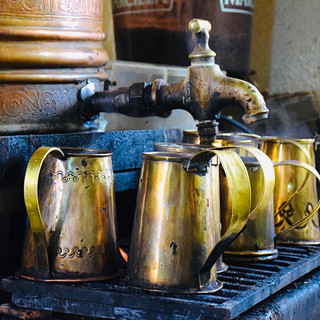


Recipe: A bunch of wild mint A bunch of peppermint Geranium flowers Orange Blossoms Marjoram Herbs Louisa Two teaspoons of black tea Sugar Hot water As a souvenir for the upcoming visit to the tannery, our tea maker gives us a to-go sprig (or 10) of mint to mask the smell of what is to come. We smelled the tannery before we saw it. It's powerful and indescribable, a smell unto itself.


The process of making leather starts with butchers bringing the hides of camels, goats, cows, and sheep to the tannery. From there, the fur or wool is scraped off, plunged for weeks in a mixture of pigeon poop and water to soften the skins and then set out to dry. How might one determine that pigeon poop softens hide, I forgot to ask. Once they are dried, the skins are dunked in vats of natural dye. Men wade hip deep in these tubs, stirring the hides so they are evenly dyed. The color of the vats is entirely dependent on the season. Red in poppy season, blue from the indigo plant and yellow from the saffron. The yellow is the only color applied by hand because of the expense required to produce the tiny yellow threads.

In the shop below, a man gave us a demonstration on how to determine if leather is real and made without the use of chemicals. So, the next time you're in a nice leather store, just bring a lighter and try to set it on fire. If it doesn't burn, you've got yourself a real piece of leather...though you'll most likely get kicked out of the store.
Making our way out of the tannery, we came upon a shop where weavers use incredibly complicated looking looms to create shimmering works of art using the threads from the aloe vera plant!


Four hours with Jamal was over in a snap and we were so grateful for his knowledge and expertise.





Kip and I sat in the cool breeze on the rooftop terrace overrun with succulents and recounted the day while the kids took some time to do schoolwork before coming up to join us.

In honor of our return to Spain, Adil made us a Spanish dinner complete with croquetas, spanish olives and pesto, tomato, queso fresca, beef tagine, and fruit. After dinner, I took Liam, Gaelan and Onora to look at some shops and decided I'd come back to purchase a typical Fes bowl. Meanwhile, I knew we had very little space in our luggage but really wanted a piece of pottery from this magical city. Yet, instead of leaving with one bowl, I ended up with a bowl and a set of 6 plates! Oops. In the morning, Violeta and I took a quick walk to her studio. As we approached her old entrance, she explains the significance of the door knockers.

There are two: One is higher pitched and about halfway up the door and the other is deeper pitched and set on the top corner. She says traditionally in Fes if a woman comes to visit, she will use the higher pitched knocker but if a man comes knocking, he must use the lower pitched one so that the woman inside knows to cover her face before opening the door.
Violeta says with conviction, "I make feminist art," and proceeds to show me piece after piece of the world inside of her mind through her decadent artwork. Using sequins, embroidery, pen and acrylic paint applied with a henna syringe, she uses her experience as a Spanish woman in a Moroccan world to express culture, women, love, loss and loneliness through traditional Moroccan mediums.


You know how you meet someone and just know they'll be in your life for a long time. Violeta is one of those people. As we left, we hugged and promised to keep in touch and then we were gone.


Amy all of it sounds incredible and so magical!! I love your descriptions and impressions absolutely amazing!!❤️
Feels like I’m almost there…your words are so powerful.
This is a treasure of a blog!! I am fascinated by the tanning and weaving and dough making processes and the photos make it all come to life!! Love the pictures of Gaelan and Onora too!!