


Málaga on the Move…
- May 22, 2022
- 6 min read
Updated: Oct 12, 2022

Just a short drive (10 minutes) from Pedgregalejo was our next stop into the old town of Málaga City for some culture, architecture, and art. In years past, Málaga had the reputation of being a port town that got passed over by tourists for other, more glamourous places. But, no longer. Málaga has a soul of its own, a culture that gives other hot spots a run for their money, and a burgeoning art scene that invites muralists from all over the world to display their work right on the street, allowing the general public to appreciate art rather than just the select few who choose to see it on a gallery wall.


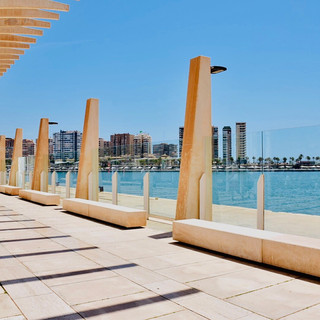


Málaga boasts some of the most dramatic and breathtaking scenery in Southern Spain just a short drive away....starting with the Caminito del Rey. (The Walk of the King) It is so-called because King Alfonso XIII walked this treacherous path just before the opening of the Conde de Guadalhorce Dam. Let me be clear, King Alfonso was no scaredy-cat king. When the pathway was constructed in 1901, it was bolted to the side of the cliff face and was little more than a 2.5 ft wide concrete path with no guardrails and thus, no stopping you from a vertical drop to your gruesome death some 100 meters below. In fact, this walk is called, "The Walk of Death" after several accidents in the 1980's and an additional 5 deaths in 1999 and 2000 due to rusting support beams and collapsing concrete. Though the pathway was eventually officially closed, die-hard mountaineers were determined to carry on and acted as unofficial guides for the experienced climber. The sections of crumbling concrete required hikers to scale the cliff face or balance along the 6-inch metal rails at the edge of the broken walkway before continuing along the path and hoping the remaining concrete would hold for just another day.
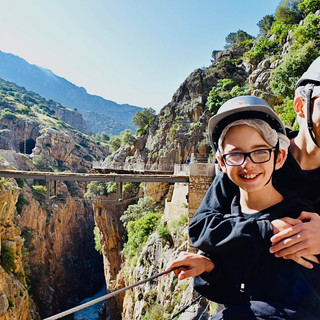
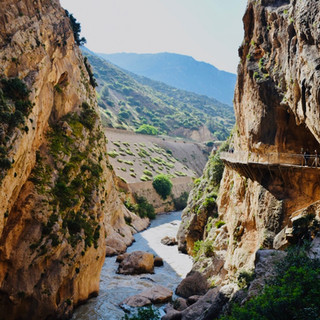
So, what reasonable mother wouldn't take her two eldest children, who have no fear of heights, on this hike? (especially Quinn whose feet are never on the ground) Let me explain before you have my head examined. In 2015, Spain had a mission to make this walk safer than it had been in the past. While the safety bar was set low, the current path is quite safe although every bit as breathtaking, though not from the fall. A 3-foot wide boardwalk with guardrails and sturdy support beams allows for a leisurely and relaxing pace around the 700-meter rock faces that weave through the Desfiladero de Los Gaitanes gorge that is carved out by the Guadalhorce River.

Though if you look over the edge of the metal railing to the rushing water below, you should prepare yourself for a little stomach acrobatics. About 6 feet below the boardwalk is the ever-present reminder of the past. The original, nail-biting, are-you-nuts-for-walking-this, crumbling pathway, is always in view. You get a sense of how far engineering has come.

So, you see, I'm not that irresponsible after all. At 5, Onora wasn't allowed on the hike and Gaelan opted to keep her company after having seen some pictures of the cliffs in the guidebook. What a sweet (err...maybe scared) brother!
We were equipped with hardhats in the case of rockfalls, though I never really understood the logic of that. If a rock falls larger than a pebble, it's still going to be pretty disastrous. Nonetheless, we wore them and felt a little more hardcore just for having them on. At the end of the walk, the gorge opens out into the Embalse de Tajo de la Encantada Reservoir for a glorious view below. The pièce de résistance is the swaying suspension bridge that crosses the gorge. With only a see-through metal grate at your feet, it allows you to get a full sense of your height.




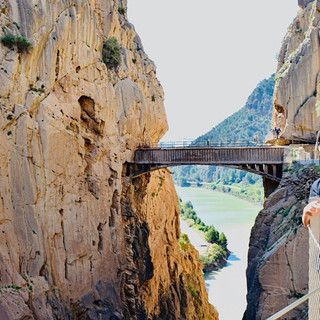







We met Kip and the little two at the end of the 7km walk at a parking lot in a "blink-and-you're-through town" called El Chorro where they picked us up and returned us to Málaga, only stopping along the way to take a photo of this beautiful mural of the Caminito on the side of a wall.
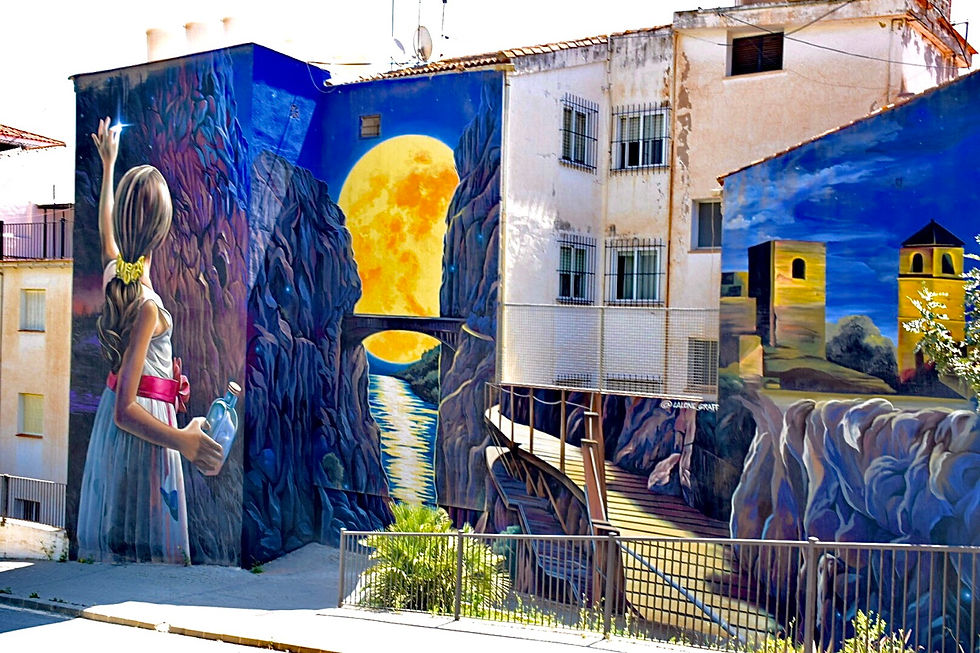
Since the Caminito's reopening in 2018, the nearby towns of El Chorro and Álora are scrambling to catch up with tourist demand. Currently, Álora is so small that even the GPS couldn't seem to get us out of the maze of streets. We spent almost 20 minutes trying to drive through this town when we could have walked it in less than 3. Up and down the rollercoaster hills that prompted screeching from the back seat (and our tires) while straining our transmission and brakes simultaneously. We started to feel like we were trapped and most likely going to be there forever. So, of course, I started singing, "Hotel California...You can check out any time you like, but you can never leave."



If one hike wasn't enough, we decided to do another the next morning in Málaga. We passed by the old Roman theatre (I guess that's redundant) built in the 1st century BCE, discovered during the renovation of the Casa de la Cultura building in 1951 which was later demolished entirely to access more of the ruins. We climbed upward to the Alcazaba, the old Moorish fortress high on a hill overlooking Málaga.




What we didn't account for during the mid-day sun was the additional stretch up to the Castillo Gibralfaro at the tippy top of the hill. On a winding steep pathway, that might have been easier with a ladder, we walked for at least 20 minutes straight uphill. Once we started, we were determined to see it through. A lovely view of Málaga City and its port awaited us at the top. The castle was built in 929 AD by the Caliph of Córdoba and later became famous for the 3-month-long siege by the Catholic monarchs, Ferdinand and Isabella, who took control by starving the resident Malagueños out and forcing them to surrender. Without mercy, the Catholics executed and/or enslaved the 15,000 people who managed to avoid starvation. Ferdinand and Isabella, it seems, were very busy doing this very thing all across Southern Spain and eventually ended 7 centuries of Muslim rule.
The walk down was much, much quicker, made even more so by Liam's "How would you escape..." game. To give an example, "You are stuck on an elevator in between floors, and none of the buttons work. You have a small mirror, a wrench, and a mechanical pencil. How do you get out?" He comes up with them on the fly and they are each more bizarre than the next but it helped pass the time until we arrived back at our apartment door.
Later that afternoon while everyone was at home doing school work, I took a leisurely walk around the old town and found myself at the Picasso Museum. Málaga, being the place of Picasso's birth, celebrates him and his artistic achievements with gusto. It was so incredibly relaxing to walk through the museum alone, silently, just taking it all in. Sometimes I need that quiet and it was a glorious 2 hours by myself. I even stopped for a fruity cocktail at a local bar and watched people go by.


Our tour wasn't quite over yet. The Soho area of Málaga was once a seedy part of town, an area known to be "off limits" after dark unless you were looking for drugs or prostitution. However, Soho has gone from seedy to chic almost overnight as Málaga decided to revamp the area and give it a flair of its own and a sense of pride...with street art. Artists worldwide, some recognizable names like Shepard Fairey, have been selected to make their large-scale paintings in this labyrinth of streets. It becomes a little like a scavenger hunt trying to find them. Thanks to http://mausmalaga.com/ which organizes and markets the Soho revitalization campaign, we roamed the streets with a mural map on my phone and a list of artist bios.

A couple of photos were not mine though I desperately wanted to find them in person. Photo credit: Man on bench https://ohmygoodguide.com/malaga/malaga-street-art-tour/
Photo credit large bird: https://streetartnews.net/2013/10/street-art-daleast-malaga.html





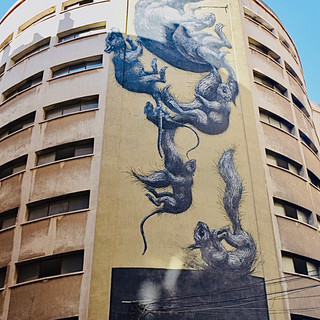


We were only in Málaga for 72 hours but it seemed we'd walked for most of those. And, we weren't done yet. We explored around the south end of the city to the famous Malagueta Beach.

A large flat, soft, and sandy beach with everything from volleyball nets, thatched beach umbrellas, playground, and basketball courts with a view of Pedregalejo seemed to be the perfect place for a little sassy beach photoshoot.






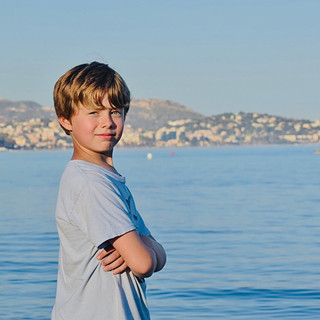


The real draw was the beach zipline that kept us entertained for an hour. Still laughing, we began our walk home at 9:15 pm and we still hadn't started making dinner. I'd say we have adjusted to the Spanish culture.


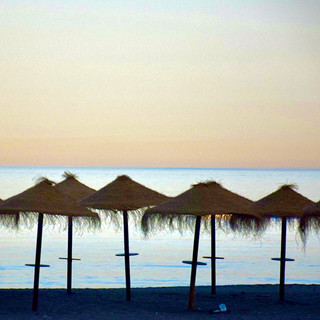


We passed through the Muelle Uno pier to see the Pompidou Contemporary Art Center and take a series of impromptu album cover shots. Unfortunately, the Pompidou has been booked for weeks so the best we could do was from the exterior.






We danced our way home at twilight when all was golden. Green parrots twittered in the palms, the lights came on and illuminated the cathedral, and large groups of English ”fútbol ” fans sang Boy George outside a cluster of bars.


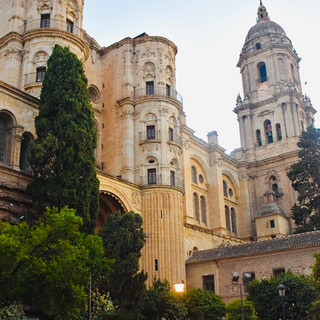


Málaga is a place I could see myself living. It has everything from authentic Spanish culture, vibrancy, art, water, an ever-present breeze, and a sense of being comfortable in its own skin. We will see you again, Málaga. I'm sure of it.



Comments