


Kyoto Storiis

Here we are: Kyoto! (Did you realize Kyoto is an anagram of Tokyo?)
Our final stop in Japan, and I am officially trying to stop time! This trip went by way too fast. I was ready to either push our flight back a week...or three...or just permanently relocate. We were determined to make the most of our last five nights, so we packed the itinerary!
After dropping our rental car near the train station, we cabbed it to the Higashiyama Ward, east over the Kamogowa river, just as darkness fell. Instantly, we became a little concerned when the taxi driver stopped at the top of a dark street and said, "I can only go this far," like he was somehow jeopardizing his own safety if he pushed on. The quiet street was empty of life and light but what could we do? Not leave the cab? We clambered out, trailing our suitcases and began our walk to our unknown destination. Suddenly, the street simply ended and turned into a rutted, dirt path wide enough for only one suitcase and its handler. Foliage crept in, narrowing the path. The only light came from my map phone, and the eyes of several stray cats lurking in the bushes. OMG, where are we going? We finally arrived at a clearing that opened to an abandoned playground, lit by buzzing lanterns. It eerily reminded me of the creaky swingset in Harry Potter where Death Eaters come to call. Google Maps had stopped responding once we hit the dirt path so we were officially flying blind at this point, pressing on by intuition and by a small image of the Airbnb. We ducked in alleyways, like rats in a maze. Awesome. Kids? How do you feel about sleeping outside? And, then...there it was!

A welcoming sight: Warmly lit, traditional and lovely inside, this authentic samurai house, named Gojo Machiya, had all the charm of the 1700's samurai heydey with modern conveniences. Paper screens, sliding doors, hanging decorative kimonos, tatami mat flooring, a chabudai (low table) paired with zabutons (cushions).
The special surprise came in the form of a watchman of sorts; our very own samurai mascot, assigned to keep vigil in the kids’ bedroom. At first, the two littles were understandably apprehensive about sleeping under the watchful glare of a sentinel samurai. We were given two very clear instructions: 1. Under no circumstances were we to flip the switch that illuminated him, and 2. the blind was to remain firmly down at night so his ominous, lurking silhouette could not be seen.
Liam, meanwhile, was having none of it. He immediately recognized the samurai's untapped potential as an instrument of psychological warfare and spent his days concocting stories designed to terrify his siblings. Unfortunately, Kip and I refused to grant him permission to torture his two younger victims, leaving Liam with no choice but to suffer in silence. He stewed. He schemed. He shook his head in exasperation as one diabolical idea after another took shape in his mind...all of them destined, for the moment, to remain tragically unused. In an effort to make him less threatening, we named him, "Georgie."

Though, on the last day, he did manage to convince his siblings to take this photo. Ever the actor, Liam took on the role of 'psycho'.

Our first sticky morning was spent in the cool confines of Kamitowa to learn the art of traditional paper making called washi. We were greeted by Hiroyuki Hayashi, a soft-spoken and gentle older gentleman sporting a doo-rag. We got right to work. Hiroyuki directed us to a large stainless steel tub filled with a milky liquid where he briefly explained the ingredients used to make the paper pulp concoction.
Kozo: beaten mulberry fibers. This is the long plant fiber that becomes the actual structure of the paper.
Neri: a slippery, syrupy liquid traditionally extracted from the roots of the tororo-aoi, a plant related to okra. While not a glue, it keeps the kozo fibers suspended and evenly distributed in the water so they don't clump together.
Water: the medium in which the fibers and neri are suspended.
Hiroyuki first demonstrates how to gather the slurry into a framed screen, a motion that feels almost like panning for gold. He dunks the screen into the vat, then gently swishes it from side to side and back again, allowing the water to drain through the mesh while the fibers settle into an even layer. Then it’s our turn. One by one, we submerge our screens and repeat the rhythmic motion, watching the watery slurry slowly transform into something that resembles paper.
For those of us making lanterns, two dips are just right; thick enough to hold together once dry, but delicate enough for light to glow through the finished paper. Onora’s wall hanging requires a little more substance, so she gives hers three layers, building up the fibers until the sheet has the weight and texture she needs.
Once our layers are complete, we selected from an array of flowers, stems, and leaves to add designs to our paper. We carefully made our choices with a pair of tweezers and gently placed them on the wet pulp.
We then overlayed a single sheet of transparent washi paper on top of the design, brushing in an outward motion to press the flowers between sheets.
From here, we dry the washi, passing the screen over a high-powered vacuum to suck the excess moisture from the paper. It must continue to dry for 10 minutes on a heated table. While we wait we are treated to candies, tea, and a fascinating and informative 10 minute video of the laborious and, dare I say, "Sisyphean" (thanks for the vocabulary word, Liam) task of making a sheet of paper.
By the end of the video, we’re all shaking our heads. The sheer amount of work is almost hard to comprehend: steam the branches, strip the bark, remove the outer bark, dry the inner white bark, soak and boil it, rinse it, hand-pick out the impurities, beat the fibers - all to turn it into pulp. In the town of Gokayama, Japan, this is their livelihood. Every. Day. And for what? Paper. Something so ordinary that most of us probably use it every day without giving it a second thought. Yet here, we’ve just watched the extraordinary amount of time, skill, and physical effort it takes to bring that simple sheet into existence. Granted, washi isn't your average A4 printer paper but it makes you look at a piece of paper a little differently.
If you want more information and to see the fascinating process, I found a UNESCO website that details the unbelievable process. It's worth a click!
Once the paper is dry, we use templates to cut the paper and prepare it for assembly.


To avoid suitcase packing hell, we assembled our creations as keepsakes after arriving to Baltimore.
By this point, we’d managed to visit the major markets in Tokyo, and Kanazawa. Kyoto's Nishiki Market was next on our list. The differences between them were sometimes subtle and other times striking. Tsukiji in Tokyo felt sprawling, makeshift, bustling, and wonderfully chaotic...a traditional market spilling into the streets. Omicho in Kanazawa was more contained but equally lively, with a distinctly traditional, local feel. Nishiki, by contrast, felt curated and polished: an elegant indoor corridor of food, craftsmanship, and Kyoto style. Each market had its own personality, but together they offered three very different glimpses into Japan’s food culture.

Beautifully designed graphic banners hang just above the center corridor while vendors slice waygu beef, chop lime green cubes of matcha, beautifully displaying their wares with artistic vision.

At the fish vendors, buckets of orange and black crabs scuttle over one another while baby eels circle endlessly through the water...both enjoying their final taste of freedom before being on someone's lunch plate.
I came to a halt at a stall that, at first glance, looked as though it were selling cherry lollipops. A closer look revealed something far more intriguing: tiny octopuses on sticks, called iidako. But why were their bodies so strangely swollen, like little balloons about to burst? Ahhh...a quail egg had been tucked inside each one.
They’re meant to be grilled and popped into your mouth whole: tentacles, egg, and all. Of everything in the market, this was my absolute favorite display. I loved the inventiveness of it, the unexpected pairing, the sheer audacity of the idea. There’s something wonderful about encountering foods that feel completely foreign simply because they weren’t part of the food culture we grew up with in America. I kept wondering: Who thought of this in the first place? And what possessed them to think, “Yes, let’s put a quail egg inside an octopus?” It felt like a tiny edible marvel.
We encountered cuts of Wagyu beef crowned with fish roe and uni (the little golden, custard-like tongues of sea urchin) alongside oysters so enormous they might as well have been an extra tongue in your mouth. There were snow crab legs (zuwai-gani) cooked by blowtorch and hard-boiled eggs topped with black caviar, and mounds of fish roe spilling artfully over their edges like wisteria cascading from a vine. Everywhere we looked, familiar ingredients had been transformed into something extravagant, unexpected, and almost too beautiful to eat.

I love sushi. I have loved it ever since I worked at a sushi bar in landlocked Athens, GA, of all places. However, after getting terribly sick from raw fish about 10 years ago, I stopped eating it. I never quite looked at sushi the same way again. And, because of my experience, the kids had grown up eating little more than avocado and California rolls. But we were in Japan. I knew this was the right place, and the right time, to dive back in.
Inside the market, we found a quiet little sushi restaurant tucked behind a sliding door, almost completely eclipsing the bustle of the market outside. We ordered nigiri and maki while watching the master sushi chef at work, meticulously slicing, chopping, and rolling each piece. The result? Melt-in-your-mouth perfection. Oh, how I’d missed you, sushi.
Three of the six of us became instant converts, and as for me? I had been reborn.
While Onora wouldn't try the fish at the sushi bar, we joked that this scrumptious custard filled pastry might be the only 'fish' she would eat during the entire trip. Turns out it wasn't a joke. No real fish ever passed her lips. One day....

For those who didn't quite fill up on sushi, we had a hot date with some wagyu beef and chicken dumplings at Nishiki Gyoza. Across from the Japanese knife vendor, we stood at a round table while passersby gently looked over our shoulders, deciding on their own lunch options. Steaming plates were brought to our table, paired with their special Kyoto shichimi-yuzu and red-miso dipping sauces.
.

We walked back home to "Georgie" for a couple of hours of much needed rest before our evening excursion to Kiyomizu-dera Temple. Along the way, we passed a sign that read “Roku” (the Japanese word for six). By then, "roku," accompanied by the hand guesture, had become one of our most frequently used words when asking for a table or making a reservation for the six of us.

A 20 minute walk entirely uphill in the 96 degree soup brought us past rows of ceramic vendors, hidden temples, and winding streets. Suddenly, we found ourselves on a quieter path that led unexpectedly into Ōtani Cemetery, a vast hillside cemetery. The space houses 13,000 stone graves and 32,000 memorial sites, packed inside the wooded landscape and tucked beneath trees and moss. During Obon, the Japanese festival honoring deceased ancestors, the quiet cemetaries are transformed. Families visit graves, clean them, leave offerings, and light lanterns. The cemeteries here aren't simply a place of death. They are an active part of Japanese family and religious life.

We arrived at the entrance to Kiyomizu-dera, looking up at the massive complex. The temple’s vivid vermilion red seemed impossibly bright, like a siren against the sky, as though it had been painted only yesterday. Broad, gracefully curved eaves swept outward above us, while intricate, brightly painted wooden columns added layer upon layer of ornament. It's enough to put a Doric capital to shame. Everywhere we looked, the craftsmanship was on full display, including the traditional Japanese nail-less joinery that holds the massive wooden structure together.

The Kiyomizu-dera “stage” is a massive wooden platform that juts 42 feet above the ground. Legend held that if you survived a jump from the stage, your wish would be granted. It's a literal “leap of faith." Between 1694 and 1864, 234 people are recorded as having made the jump, and remarkably, about 200 survived. What condition they were in afterward is another matter entirely. Thankfully, the practice has long since been banned.
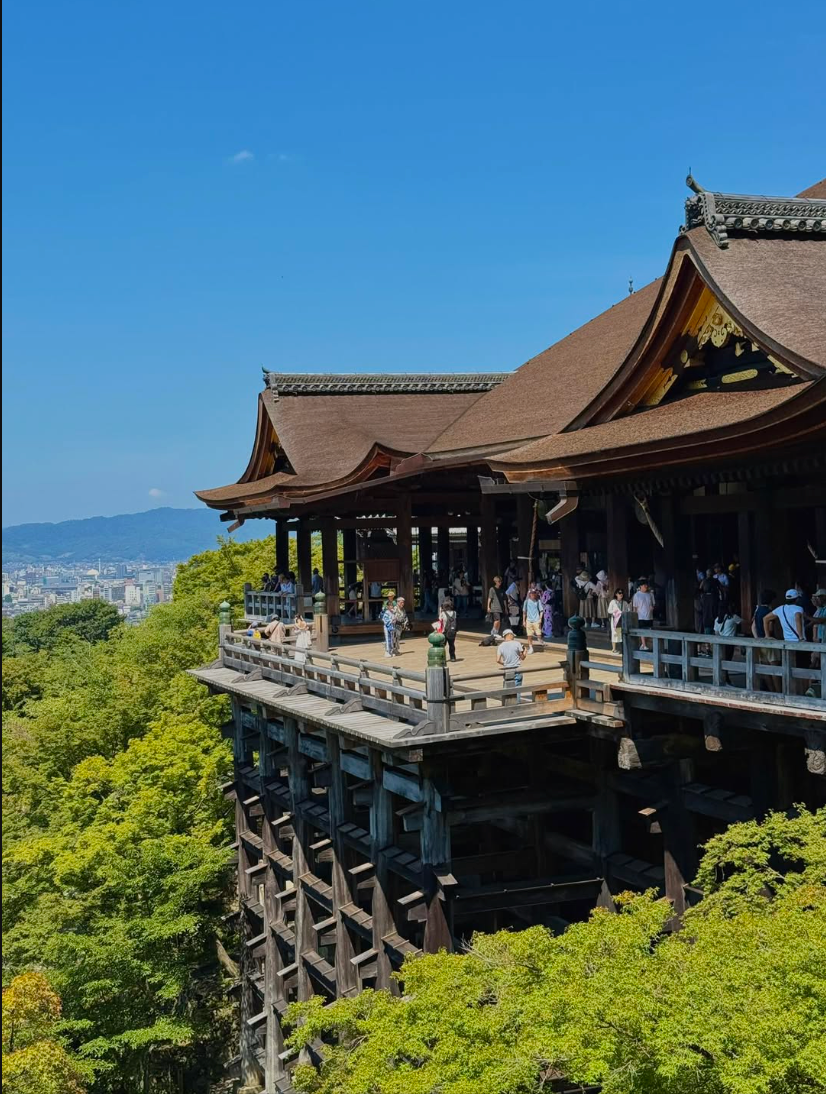
Behind Onora and me is the jumping platform. It looks much higher than 42 feet!

Tourists come to Kiyomizu-dera at all hours of the day, a steady stream of feet crossing the wooden stage, cameras pointed toward the sweeping landscape and views across Kyoto. But the stage has a purpose beyond the view. It was originally designed as a place to worship Kannon, the bodhisattva associated with mercy and compassion, with your back turned to the landscape.
Inside the main hall, the atmosphere shifts from the open, airy stage to a more intimate and contemplative space. Warm golden lanterns hang above elaborate Buddhist altars, devotional objects, and intricate decorative details. The deeper you move into the hall, the more sacred the spaces become, culminating in an innermost sanctuary that is closed to the public and reserved for the temple’s most sacred objects.
Down a long set of stairs is Otowa Waterfall, where the water is divided into three distinct streams. Long lines of visitors waited patiently for their turn to catch the water with long-handled ladles and take a sip.
And, of course, each stream comes with its own promise. Facing the waterfall, the water on the right is said to bring health and longevity, the center promises luck in love, and the left brings success in school. But choose carefully: tradition says you shouldn't drink from all three, lest your wish be considered greedy. So, choose wisely.


While the sun was performing its own "plunge" we still had to find dinner, and get home to Georgie who waiting for us in the dark. We stood under the spray of a fine mist for a few minutes for a cooling boost before making the return walk home.
Below is one of my favorite photographs I took in all of Japan. It evokes a particular feeling that brings me to Kyoto in ways that no other photo can. I can almost step back into the frame and feel the hazy damp of the heat on my skin, see the angle of the afternoon light in my eye, catching the edges of the architecture, hear the steady shuffle of footsteps and the low thrum of visitors moving around me. It doesn't feel like a photograph of a place. It has captured the texture of being there.

We strolled through the famed and rather expensive Gion District, back to the Higashiyama Ward where we came upon a taco and burger restaurant. As we entered, a shout of welcome erupted. Friendly staff attended to our every need, even asking to take a photo with us. We grabbed seats at the bar and dug into pork canitas tacos and the biggest burger you've ever seen. Then, the cooks handed us all pairs of black gloves. The was a brief moment of collective confusion. Are we supposed to be committing murder or eating with them? I guess even a burger demands proper hand protection. Cleanliness in Japan knows no bounds!
The following morning was an early wake up for taxi ride and a walk in the Arashiyama Bamboo Grove on the east side of Kyoto. Bamboo is prized in Japan for its strength, resilience, flexibility and longevity. It also has its practical uses in crafts, basketmaking, architecture, and food. The walking path is approximately 1/3 of a mile of towering bamboo, each stalk growing up to three feet in a single day! However, the most magical part of the experience is the sound of the trees on a windy day. Apparently, the stalks creak, moan, and knock hollowly against one another like a ghost drifting through the trees. In fact, it is named one of Japan's best soundscapes. Unfortunately, we had a bright, sunny and particularly windless day.

To the left of the entrance to the Arashiyama Bamboo Forest stands the gate to Tenryū-ji, a major Zen temple. Tenryū-ji’s buildings have burned again and again over the centuries, rebuilt each time, while its garden has endured, though, changing, growing, and evolving with the seasons in true Zen philosophy.

Designed nearly 700 years ago, the garden deliberately incorporates the mountains of Arashiyama into its composition, allowing the garden to seem to dissolve seamlessly into the landscape beyond it. There are no walls to contain the view, no hedges or fences to mark a hard boundary. Instead, you simply meander through the grounds, following winding paths, passing understated landscape plaques, and skirting ponds that mirror the first colors of autumn. Along the way, we watched visitors toss coins into the open mouth of a little frog statue, hoping to invite a bit of luck.
Next up: Gio-ji Temple! While a day of temple sight-seeing might sound like you could get a serious cas of museum-itis, it's really just like taking a walk in a beautiful landscape. In this case, Gio-ji was the smallest of all the temples, the altar space just enough to fit 4. We found ourselves covered in a dense treed lanscape, that gave just enough light through its canopy for lime green moss to thrive.

The perimeter of the space was lined with tall bamboo, making the lanscape even more intimate. It helped that we were the only ones there...well, except for the cicadas. Take a listen to hear them cheering for us.
I remember one of the first books I read that was equally enjoyable while also having literary consequence was "Memoirs of a Geisha" by Arthur Golden. Since that time, I've had a fascination and many questions about the world of these elegant but inscrutable women. How they came to be geishas? What emotions do they need to suppress to deliberately construct their finely crafted persona? Do they have dreams beyond their role? Are they happy? What better way to understand some of these questions, we thought, than getting a first-hand account.

Speaking through a translator, our host was a maiko - a geisha in training. We were welcomed to sit around the perimeter of a tatami mat while the maiko gracefully made her entrance and was introduced to us. They educated us to see the visual difference between maikos and geishas. For instance, maikos wear shorter sleeves, a trailing obi (backpack), and real hair wrapped in a neat bun with colorful ornaments. Maiko are generally seen as more youthful, colorful, and ornate while geisha are seen as refined, sophisticated, and understated.
With precision and practiced movements, she performed a traditional Japanese dance with all the grace of a trained disciple. It was so practiced that even her head tilts were clearly something she could do in her sleep. Yet, her facial expressions belied no emotion whatsoever, like one of my old Madame Alexander dolls sitting in a glass cabinet, unmoveable and pleasantly flat. Note: To protect her image, I am required to blur her face for these posts.
The maiko performed a traditional tea ceremony where every movement is precise, restrained, and attention is paid and choreographed down to the smallest of gestures. From the way she enters, kneels, folds the cloth, cleans the tea bowl, lifts the ladle, and turns the bowl, the goal is for this to look so practiced that it looks effortless, not mechanical.
Even the objects selected as part of the ceremony have purpose and meaning. The sweets, kettle, flowers, bamboo whisk, and bowl are decisions made to reflect the season, the guests, or the setting.

We watched the tea ceremony in preparation for making our own matcha tea. And, when I say "making our own tea," I mean stirring the hot water into the powder. You think that sounds easy, don't you? Well, when you watch the maiko stirring her own tea, it's like trying to watch the wings of a hummingbird. You can't. They're moving too fast. Using a back and forth flicking motion, your intent is to flick fast enough to create a froth of green bubbles. I think all of our hands cramped up immediately. It's just not a natural movement, especially at mach speed. I threatened to overturn the tea onto the tatami mat and promptly stopped for fear of being exiled. The maiko left the room while we made a mockery of her craft and enjoyed the sweets and tea. Thank goodness! Doing this in front of a maiko, with no facial expressions, might leave us all feeling unfairly judged. Here's the process: After you create your froth (if you do), then wave your whisk back and forth through the bubbles to burst them. Last, you simply stir once in a clockwise motion to remove the foam.
Onora took one sip of her matcha, the liquid going down like bitter medicine. After the first sip, her eyes desperately searched mine, fearful that she'd have to drain the cup. Quinn clearly knew she was struggling to swallow it, as evidenced by his facial expression. All it took was a nod from me, while mouthing the words, "It's okay if you don't like it," and she happily passed hers along to Gaelan who drank it down.

Finally, the maiko returned to the room, sat on the floor and was willing to accept questions. I had some prepared! I've been waiting for this since 1997. However, I'd noticed the small print on our handout we were asked to review. The rules were clear. We weren't going to get to have an intimate conversation with a maiko. Instead, the questions we were allowed to ask were scripted and handed to us. I'm not sure what I expected. The most interesting tidbit she shared, however, was that her most difficult part of her training was learning to sleep on a takamakura in order to preserve her hairstyle during the night. It's not a pillow in the slightest. It's an elevated laquered stand with a small padded top.

For 5 years, they are required to sleep with a small pedestal underneath the neck. Many will scatter rice or sand beneath the takamakura before sleep. If the rice or sand is disturbed in the morning, she has failed to protect their hair.


That night, the sushi converts among us were already plotting our next fix. We crossed the Kamogawa River and slipped into Samurai Restaurant Omakase Kamogawa, where we were greeted like old friends rather than six strangers wandering in off the street. We confessed that some of us were sushi rookies, and the chef responded in the best possible way: a beautiful plate of nigiri appeared before us, destined for sharing. One bite in, the rookies were looking considerably less rookie.

As delicious as the Nishiki Market sushi was, we were enamored with not only the food here but also with the staff. While we waited for the food, the owner took Gaelan and Onora out to the river to feed the ducks and this beautiful bird below.
Our effusive praise of the sushi seemed to inspire the chef to keep the surprises coming. Next came the sake. He set a tiny glass inside a wooden box and began to pour. And pour. And pour. Just when I was certain he'd reached the top, he kept going until the sake bulged above the rim in a perfect meniscus, then spilled over the sides and pooled in the box below. Apparently, one drink in Japan can mean three. Who was I to argue?
The next surprise was salmon roe, little orange pearls piled onto rice and wrapped in a crisp sheet of seaweed. I had seen it countless times on sushi menus but had always managed to avoid it. Something about those perfectly round, translucent orbs has always given me the shivers. But there I was in Kyoto, surrounded by sushi, and apparently my past excuses had run out. “Thank you,” I said, smiling bravely as I prepared to pop the whole thing into my mouth. Here is my reaction.
Quinn, our guide for all things Japan, asked for the check in Japanese and "paid the tab". He was smitten with the whole scene. In fact, he was ready to abandon the rest of the trip and asked if they needed a sous chef.


Back at home, we chased down our sushi with our own little tea party, cups of steaming tea in hand as we laughed, talked, and relived the day's adventures.

I could probably write an entire post about what happened the following morning. We signed up for the Samurai Experience, expecting a couple of hours of sword swinging and historical fun. What we got was something far more fascinating: a deep dive into samurai history and culture, the discipline of swordsmanship, and, unexpectedly, Zen meditation. Two hours later, we walked out having learned much more than how to wield a sword...and with a whole new appreciation for the mindset behind it.

First we were dressed the part! Because you know what they say, "The clothes make the man." We sat in an 250 year old authentic samurai house with defensive features such as hidden doors and multi-layered walls. It used to be the home of the prison warden at Nijo Castle whose descendants have passed the house down to Samurai Experience in an effort to keep the way of the warrior alive through education.

Our lovely host, a woman from Australia, now living in Kyoto, served as our translator and history buff. Before we ever touched a sword, we were given a brief history of the samurai, their rise as Japan's warrior class, their place in the Edo-period social and political order, and their eventual disappearance as a formal class during the Meiji Restoration. But the lesson wasn't really about dates and battles. It was about the samurai ideal: discipline, control, honor, and the belief that mastering the sword required mastering yourself.
In samurai culture, the sword is much more than a weapon. It is deeply tied to identity, control, discipline, and status. It is considered "the soul of the samurai."
Throughout the course of two different demonstrations, the movement associated with drawing, cutting, and resheathing the sword with precision and economical movement and displays the artistry of the samurai. His targets: Rolled up, wet tatami mats that are said to mimic the feel of slicing through a shoulder. Delightful!
Clad in black robes, we were led outside into a gravel courtyard to learn the art of the cut. Our swords were wooden trainers, but standing there with one in my hands, I suddenly felt the weight of what we were about to do. I repeated the instructions silently: "knees bent, shoulders loose, breathe, sword at the hip, don't muscle it."
First, we learned two cuts: left and right cuts. Each began with the same three-count rhythm.
“Ichi!” The sword rose high above my head.“Ni!” Without dropping it, I shifted my arms to one side, the blade poised beside my head.“San!” I brought the sword down in a single, decisive diagonal arc toward the ground.
Left. Right. Left. Right. Again and again.
“Ichi!”
“Ni!”
“San!”
The instructor's voice cracked across the courtyard, and six wooden swords rose and fell in unison. The trick, we quickly discovered, was not strength. It was control. The less we fought the urge to muscle the sword, the better the cut became. However, I had more difficulty with this than most as I ground my teeth and tried to murder the air with a sense of ferocity. I can be a bit aggressive, I know.
Finally came the crowd favorite...or at least the one with the most alarming name: “The Stomach Slicer.” The rhythm was the same, but this time the movement came from the body.
“Ichi!” I twisted at the waist, sweeping the sword around until it hovered horizontally at my side.“Ni!” I pulled it farther behind me, winding up like a human mousetrap.“San!” I rotated back the other direction, bringing the blade around in one long, horizontal sweep.
Thankfully, our targets were imaginary. And, thankfully for everyone standing nearby, so was my ability to actually slice a stomach.

Ahhh...but apparently they thought we were trained enough to wield actual swords to cut actual targets. They had a lot of faith in the six of us and we had signed no waivers. I love Japan. Each of us had an opportunity to make 4 cuts on our targets. Right side, left side, and two stomach slicers. If we were precise enough, on the stomach slicer, our sword would slice through without toppling the piece over. If you made two horiztonal cuts without toppling the target, you got an additional charge to "split the difference" and try your hand at cutting between your first two cuts.
Only Kip and Quinn managed this feat, shocking us all. After Kip's "split the difference" cut, where he literally split hairs between his first two slices, one of the masters looked at him and delivered what may be my favorite compliment of the entire trip: “I'm not saying I didn't have faith in you...but I didn't have faith in you. That was surgical!”
Here are a series of action shots and videos....
The true mastery of the sword, we learned, isn't simply understanding the physical movements. A warrior must also learn to quiet the mind and control what is happening within it. Zen meditation was used to settle the blood and steady the mind after the intensity of battle.
We were led into a quiet room scented with incense. Copper bowls sat on the floor, and cushions marked our places in a loose semicircle. We turned our backs to the center, closed our eyes, and settled in. For the next ten minutes, the only sounds were the deep, resonant notes of the copper bowls as the padded mallet struck them. Incense hung in the air. We focused on nothing but our breathing, letting the adrenaline of the sword practice slowly drain away.
The final piece of our experience was sword appreciation. We were given the extraordinary opportunity to hold a 600-year-old sword and examine its craftsmanship up close: the intricate silk wrapping of the handle, the stitching, and the painstaking details that had somehow survived six centuries. But there were rules. Two, to be exact: a heavy glove on the hand holding the sword, and a small piece of paper folded between our lips. The glove protected both us and the blade; the paper prevented even the tiniest bit of moisture from our breath or nose from reaching the steel and causing rust.
It felt almost absurdly cautious until you realized we were holding something that had survived 600 years. Suddenly, breathing seemed like a pretty serious responsibility.

Our afternoon excursion brought us to a traditional wagashi-making workshop, where we would learn to create those beautiful little Japanese sweets. There was just one tiny problem: we had somehow enrolled in a Japanese-language class.
“Ummm… Quinn?”
Our resident translator took one look around the room, listened to the rapid-fire Japanese instructions, and essentially threw up his hands. This was well beyond his pay grade. For a few minutes, we were completely lost. Not a little lost. We were six people staring blankly at a Japanese instructor who was explaining something very important about sugar, beans, or perhaps the meaning of life, while Quinn looked increasingly relieved that no one had asked him to translate it.
Then we spotted the projector.
Every move the instructor made was displayed on the screen in glorious detail. Ah. We had found our language. Forget vocabulary! We would communicate through hand movements.
I'm sure we missed fascinating explanations about the history of wagashi, the ingredients, and probably several cultural details that would have made us better-informed travelers. But we could follow a demonstration. And, miraculously, that was enough.
We made three different wagashi, each inspired by a Japanese flower. Could I tell you which flowers? Absolutely not. But they were colorful, delicate, and ridiculously fun to make. Armed with tiny wooden tools, graters, and chopsticks, we poked, pressed, shaped, and sculpted our way through the process. We even got to show our new found skills at matcha mixing, as they served tea to enjoy with our sweets. Nevermind that our wrists weren't as agile as we would have liked, we were proud that we at least knew the technique.

Tuckered out and perhaps a little queasy from one too many wagashi taste tests, we spent a slow, restorative afternoon in the samurai house, writing, drawing, and catching up on a little work. But as evening approached, we packed up and headed out for one more sight. I told you we had plans.
And we timed it perfectly.
We arrived at Fushimi Inari just as the light began to turn golden. The vermillion torii gates glowed in the late-afternoon sun, their color cooling as shadows began to descend. If you've never been to Japan, you've almost certainly seen photographs of these gates. They are instantly recognizable and unmistakably Japan.

But walking through them is something else entirely. A torii marks the passage from the ordinary world into sacred space. And at Fushimi Inari, that passage doesn't happen just once. It happens again and again, beneath 10,000 gates that wind their way up Mount Inari prompting Quinn to break out in song, "Well, I have walked 10,000 gates and I have walked 500 more..."
Fushimi Inari traces its history back more than 1,300 years, to 711 CE. Of course, the thousands of torii we see today weren't standing here in 711. Most were donated over the centuries by businesses and individuals seeking prosperity, success, or simply giving thanks. From the front, the gates are uniform and solid vermillion, a color traditionally associated with vitality and protection. But turn around.
The back of each gate tells a different story. Carved into the wood are the names of the donors and the dates of their offerings. Together, the gates form a living historical record.
For the next hour and a half, we followed the trail upward, walking through what felt like an endless tunnel of orange-red. The famous gates became less crowded the higher we climbed and the shadows stretched diagonally across the path, creating bold stripes.
And then Fushimi Inari began to reveal its quiet side. As we reached Shin-ike Pond, halfway up to the summit, the path turned, taking us through a forested path on the edge of the pond. Here, tiny shrines were tucked among the trees, weathered stone monuments with thick, braided ropes attached to bells, hung silent. Lichen collected on the stone and fox statues watched us in the dim light. There was a ghostly eerieness here, a silence that felt like something holding its breath. At this time of day, halfway to the summit, we were the only visitors. We continued forward in the dark, snaking our way through the trees around the edge of the pond and through the forest....until the darkness felt a little too dark.
A little scared and unnerved, we turned around and found our way back to the stone path.

We returned the way we came, emerging from the darkness into the light. From this new perspective, the temple was illuminated by lamps within, glowing in the warm evening, creating a stunning final passage out.

Our final day was upon us, culminating with the last of our four artistic workshops: Kingtsugi. Kingtsugi means “golden joinery" and is the Japanese practice of repairing broken ceramics with lacquer mixed or decorated with gold. In this way, the Japanese illustrate the principle of "wabi-sabi." The fascinating philosophy behind it is that the repair isn't something to hide. The cracks become part of the object's history and are emphasized rather than disguised.
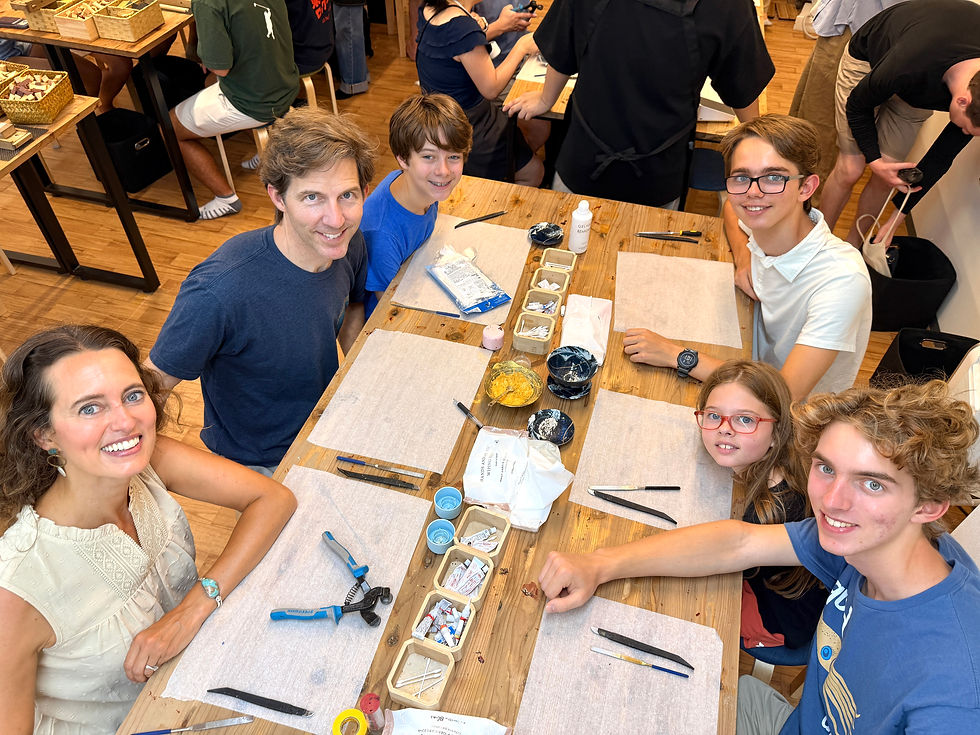
In our case, we had nothing on hand that needed repairing, so we had to do something rather counterintuitive: break the ceramic piece first. It felt strange, almost wrong, to deliberately break something simply so we could repair it.
The next step...and, frankly, the most taxing...was filing the edges of our ceramic pieces. I had barely stopped sweating from the 20-foot walk from our air-conditioned cab into the workshop, and yet here I was again, soon coated in another layer of sweat as we spent a full hour carefully filing each piece.
Every so often, we’d hold up our work for Maya, our guide, hoping for the verdict we desperately wanted to hear: “Looks great!” Instead, time after time, she would inspect our pieces, shake her head, and gently say, “A little more.”
A little more.
So we filed. And filed. And filed.
Finally, we got the go-ahead. We stretched our cramped hands...or, in my case, planted myself directly in front of the oscillating fan...and moved on to the next stage.
First, we glued the broken pieces back together, which still felt strangely counterintuitive after having deliberately broken them in the first place. Once the pieces were secure, we applied lacquer along the seams and then carefully worked gold into the cracks, transforming the fractures into shimmering lines.
The final step was to gently wipe away the excess gold, revealing the finished piece!

Ok, so I don't make a habit of going to a mall on vacation...well, I don't make a habit of going to a mall. Period. But Liam took one look at Aeon Mall on the night we arrived in Kyoto and put his foot down. "We are going shopping here at some point! I want to experience Japanese shopping." So, we obliged. Naturally. Seeing as no one had gotten a Japanese souvenir, they took it as an opportunity to remedy the situation.

We wandered the shops, browsed the aisles, and gave ourselves over to Japanese mall shopping. Liam succeeded with some distinctly Japanese t-shirts and a boxy jean jacket in the style he'd been coveting. The rest of us came away with nothing but a delicious lunch...at a mall no less!

Our last evening was spent packing while repeatedly refreshing our flight information as reports that Typhoon Chan-hom was causing delays and turning our departure into a giant question mark.

Luckily, our flight the following morning on Air Nippon from Osaka to Tokyo departed on schedule, miraculously being one of the last ones out that day before they grounded all domestic flights. Once we landed in Tokyo, though, we weren't out of the woods. We waited on the tarmac for an extra hour as rain pelted the windows until we heard the captain say, "Flight attendants. Prepare for departure." And we were off... As the plane lifted into the grey skies, Japan disappeared beneath us. Sayonara, Japan! Until we see you again.


Comments